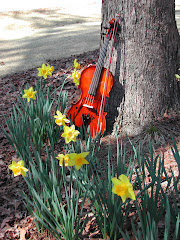
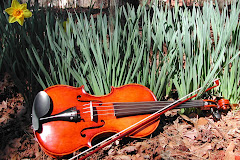
I read an interview with Michelle Williams in Elle magazine this morning. She's the ex fiance and mom to Matilda (Heath Ledger), of Dawson's Creek fame. Yes, I watched Dawson's religiously for 6 years with Cuyler. Anyway, Michelle is a free spirited, deep thinker and I am stealing one of her thoughts. "Yesterday I had a break through - one where I got to the edge of my abilities with my viola and took a step across the line - a baby step, mind you." Of course she was talking about acting, not playing the viola.
I had a good hour of practice Saturday morning. I love weekends - I get to practice in the morning and drink coffee. I am a morning person and it would behoove me to get up early enough to practice, exercise, meditate, etc. before work, but I also love to sleep. I know those are on the opposite ends of the spectrum, but I make the best of it. Anyway, I felt like a real musician yesterday morning. Fingerings, intonation, shifts all came so easily. I "heard" my intonation mistakes and made adjustments quickly - this is a big deal for me. I have always tended to plant my fingers and bulldoze through the notes whether I was in tune or not. My musician's ear is definintely improving!

Sunday, March 30, 2008

Thursday, March 27, 2008
more progress
I am amazed. I can play 2 of our 6 pieces fairly well already. AND... I'm making progress on the Wagner. It only has a few tough spots that have me still stumped. I plan to work through each piece entirely and get to a comfortable level before I move on to the next one. Lorra's fingering suggestions have helped.
Wednesday, March 26, 2008
progress
After being totally overwhelmed with the new SCSO music for several days - I'm talking wringing of hands and wailing out loud - I feel better after last night's rehearsal. The principal violist was my stand partner and she asked if I wanted to use my music instead of hers. That worked out great for me as I had marked many fingerings and bowings already. She made more suggestions and helped mark up my music the rest of the reheasrsal, so I feel my practice time will be more effective this week. There is this one spot in the Wagner that is just killing me! I can't even play it very slowly. We have two weeks off from church orchestra, so I can really devout my time to this set.
Sunday, March 23, 2008
happy easter
It's been a good day. The Easter service at church was nice, the orchestra sounded great as usual, I only boo-booed once, the girls and boyfriends came for lunch, the easter bunny brought gifts and candy. We had a nice relaxing afternoon. I'm wiped out and don't know if I'll get my 3 minutes in tonight or not. I could close my eyes and sleep for a week.
Friday, March 21, 2008
Good Friday
The church quartet played for the Tenebrae service tonight. It is my favorite Methodist event of the year. I really like the way they tell the story of the crucifixion and extinguish the candles one at a time until it is dark in the sanctuary- a big boom on the gong symbolizes the final breath of Christ's life. Everyone leaves in silence - they don't even talk in the parking lot! The piece we played was fairly simple and I give myself an A- for this performance.
Tuesday, March 18, 2008
too many notes!
Just got back from orchestra (SCSO) rehearsal and we got the new music for our next concert. I don't remember all the titles, but is is all well recognized stuff that has been used in movies and such over the years. The pieces are sooooo long.... and there are sooooo many notes the pages are solid black! None of it is easy. I can not imagine how I will be able to get it all under my fingers in just 5 weeks! Yikes! Thank goodness I have Spring break in 3 more weeks - that will give me some extra practice time.
The Rest of the Story
A wonderful true life account from Paul Harvey:
Christmas Eve in Princeton, New Jersey, usually fulfills the picture postcard promise of Christmas. And it was so, on that particular Christmas Eve, long ago. Church bells pealed in the distance. A light snowfall kissed the quaint Princeton houses, and door to door carol singers made their way . . . to one particular door. The violinist's home. The gentle violinist. "O Little Town of Bethlehem," the boys sang,"how still we see thee lie . . ." In moments the door opened . . . and the gentle violinist stood in the doorway to greet the carolers." Above thy deep and dreamless sleep, the silent stars go by . . ." The musician turned away . . . turned back into the house. Shortly he reappeared . . . with his violin! There he completed a picture too intimate for a postcard . . . a sound too inspiring for any but this story. The great man . . . the gentle old musician . . . accompanied the midnight carolers on his beloved instrument through each verse of the age-old hymn. Then, without a word to break the spell, the young people turned away silently and the old man slowly closed the door. At once there was only the distant pealing of the bells, and the snowfall.
And as this story is true . . . this real life scene from a year long past . . . if it is made more wonderful, it is not because a seasoned violin was brought out of retirement for one last spontaneous recital, but because the violinist himself had the best reason of all not to celebrate that snowy Christmas scene. The great genius was a Jew, and so revered was he that the very presidency of Israel once could have been his. But here is THE REST OF THE STORY.
Musicians will tell you, every great genius has their idol. This violinist's was Mozart. In his own words, the musician described the turning point in his early musical career; "I really began to learn only when I was about thrirteen years old . . . mainly, after I had fallen in love with Mozart's sonatas. The attempt to reproduce their singular grace compelled me to improve my technique. I believe, on the whole, that love is a better teacher than sense of duty . . . with me, at least, it certainly was. "Once, a freind asked the violinist to comment on modern times. When the musician was a boy, wars were fought with rifles and cannons. Now the entire world might be devestated. What did that mean to the old man? The violinist hesitated, sat back thoughtfully in his chair. "It would mean," he said at last, "that people would no longer hear Mozart."
For him, this most deeply conveyed the end of civilization. On many an occasion, he would break an hourslong chamber music session with the same observation. Mozart's music was so pure that it seemed to have been ever-present in the universe, waiting to be discovered by the master. So the great genius had an idol . . . and that idol was Mozart. For him, Mozart was what the world was all about.And when this violinist was offered the highest Jewish honor . . . the presidency of Israel . . . he declined, saying that he felt unqualified for a role that involved human relations. Yet who could have felt human warmth more deeply than the musician who worshipped Mozart than the old Jewish gentelman who serenaded Christmas carolers from his last home? For him, Mozart was not a compser, but a discoverer, a discoverer of celestial music that lay waiting in the universe. So when the violinist began to explore the universe, those closest to him believed that he was merely searching . . . for what Mozart had found. More logically this musician's idol might well have been Sir Isaac Newton, but he counted himself first as a violinist. For the musician who worshipped Mozart . . . the revered genius who could have been president of Israel . . . was the man who literally altered the meaning of infinity, hoping to discover . . . music. He was Dr. Albert Einstein
Christmas Eve in Princeton, New Jersey, usually fulfills the picture postcard promise of Christmas. And it was so, on that particular Christmas Eve, long ago. Church bells pealed in the distance. A light snowfall kissed the quaint Princeton houses, and door to door carol singers made their way . . . to one particular door. The violinist's home. The gentle violinist. "O Little Town of Bethlehem," the boys sang,"how still we see thee lie . . ." In moments the door opened . . . and the gentle violinist stood in the doorway to greet the carolers." Above thy deep and dreamless sleep, the silent stars go by . . ." The musician turned away . . . turned back into the house. Shortly he reappeared . . . with his violin! There he completed a picture too intimate for a postcard . . . a sound too inspiring for any but this story. The great man . . . the gentle old musician . . . accompanied the midnight carolers on his beloved instrument through each verse of the age-old hymn. Then, without a word to break the spell, the young people turned away silently and the old man slowly closed the door. At once there was only the distant pealing of the bells, and the snowfall.
And as this story is true . . . this real life scene from a year long past . . . if it is made more wonderful, it is not because a seasoned violin was brought out of retirement for one last spontaneous recital, but because the violinist himself had the best reason of all not to celebrate that snowy Christmas scene. The great genius was a Jew, and so revered was he that the very presidency of Israel once could have been his. But here is THE REST OF THE STORY.
Musicians will tell you, every great genius has their idol. This violinist's was Mozart. In his own words, the musician described the turning point in his early musical career; "I really began to learn only when I was about thrirteen years old . . . mainly, after I had fallen in love with Mozart's sonatas. The attempt to reproduce their singular grace compelled me to improve my technique. I believe, on the whole, that love is a better teacher than sense of duty . . . with me, at least, it certainly was. "Once, a freind asked the violinist to comment on modern times. When the musician was a boy, wars were fought with rifles and cannons. Now the entire world might be devestated. What did that mean to the old man? The violinist hesitated, sat back thoughtfully in his chair. "It would mean," he said at last, "that people would no longer hear Mozart."
For him, this most deeply conveyed the end of civilization. On many an occasion, he would break an hourslong chamber music session with the same observation. Mozart's music was so pure that it seemed to have been ever-present in the universe, waiting to be discovered by the master. So the great genius had an idol . . . and that idol was Mozart. For him, Mozart was what the world was all about.And when this violinist was offered the highest Jewish honor . . . the presidency of Israel . . . he declined, saying that he felt unqualified for a role that involved human relations. Yet who could have felt human warmth more deeply than the musician who worshipped Mozart than the old Jewish gentelman who serenaded Christmas carolers from his last home? For him, Mozart was not a compser, but a discoverer, a discoverer of celestial music that lay waiting in the universe. So when the violinist began to explore the universe, those closest to him believed that he was merely searching . . . for what Mozart had found. More logically this musician's idol might well have been Sir Isaac Newton, but he counted himself first as a violinist. For the musician who worshipped Mozart . . . the revered genius who could have been president of Israel . . . was the man who literally altered the meaning of infinity, hoping to discover . . . music. He was Dr. Albert Einstein
Subscribe to:
Posts (Atom)